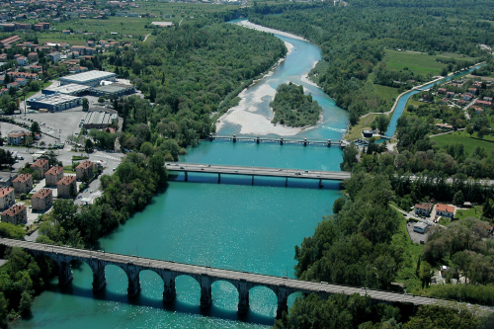
- The Isonzo River (Soča in Slovenian) is a transboundary river. It originates in the Alpine Trenta valley (Italy) at an altitude of 935 and flows into the Adriatic Sea, with a delta near Monfalcone (Italy).
- The Isonzo catchment basin subtends a total area of approximately 3400 kmsq of which is about 1150 Kmsq, that is about one third, in Italian territory;
- The basin is prone to floods.
- Main pressures on water resources from both countries are agriculture and hydropower with significant concerns over the impact of climate change.
- The basin is prone to floods. The safety of the whole basin depends on the management of large Slovenian dams, but current transboundary flood prevention agreements are insufficient.
- Although several bilateral agreements between Italy and Slovenia (e.g., Osimo agreement, 1975) facilitate cooperation, a shared framework for managing the whole basin with a specific focus on Nexus issues and taking into account climate change, which is threatening the viability of current agreements, is critically missing.
- Main pressures on water resources from both countries are agriculture and hydropower, with significant concerns over the impact of climate change.
- Local authorities (responsible for flood management, civil protection and policy): Friuli Regional Authority, Friuli Region Civil Protection
- ISPRA (Italian National Institute for Environmental Protection and Research
- Water authorities (responsible for flood management, water policies development): AAWA, Friuli Regional Authority
- Environment Agency (Arpa FVG), Environmental authority in Slovenia (ex ARSO), Drainage authorities;
- Energy authorities (responsible for the management of dams)
- Farmers associations
- Analyse the status of the actual management plan in relation to projected climate changes.
- Find and test best solutions and best practices to guarantee future sustainability.
- Find an equilibrium between different uses of water along the Nexus (flood/food/energy).
